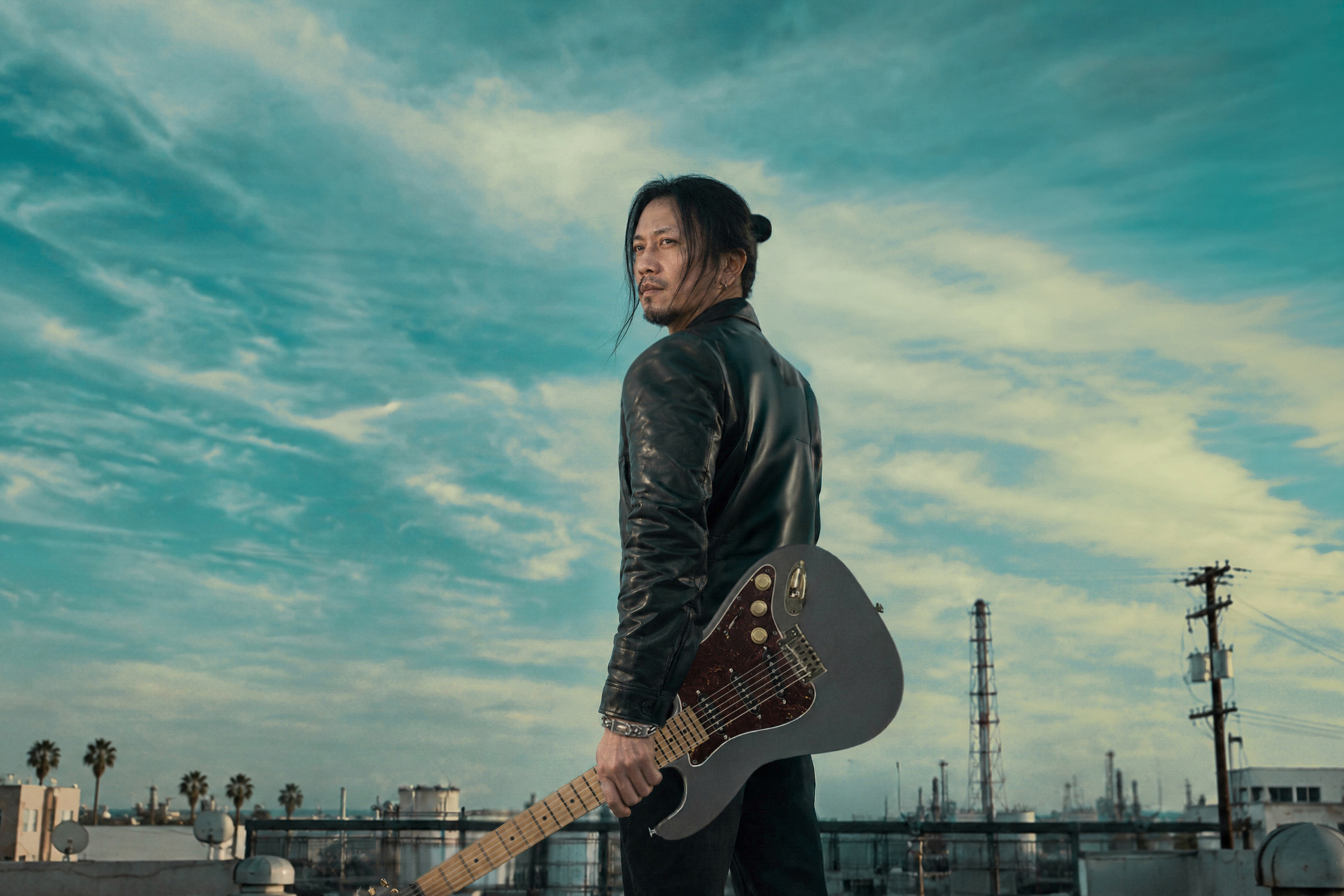
Sadaharu Yagi knows that something unplanned can change a song. When he began working on “The Road Back Home,” he used a cheap djembe and a pair of drum brushes because they were the instruments he had nearby. He simply wanted to record the idea before he forgot it. When he listened back a few days later, he noticed that the sound did not quite fit, but he also realized there was something interesting about it. So he decided to keep it.
That story sums up his approach to making music. Yagi is a Japanese artist based in Los Angeles whose work draws on art rock, post-punk, electronic music, and elements of Japanese musical tradition. He has also built a long career as a producer and engineer, earning one Grammy and two Latin Grammy Awards. In this interview with TML, he discusses “The Road Back Home” and “Computer Generation,” along with the mistakes that end up improving a song, his relationship with technology, and why loneliness, the passage of time, and the idea of freedom appear so often in his work.
You have explained that, for you, the studio is not simply a place where a performance is documented. Why do you see it that way?
Human beings are analog. When people come together in a space, misunderstandings, mistakes, technical problems, and unexpected reactions happen. Sometimes an accident changes a sound completely, and you realize it is better than what you planned. I have seen that many times, and great records are full of moments like that.
Limitations matter too. In a studio, time is limited, so each step demands real attention and commitment. At some point, you stop going back and build on what has happened. I think some of that intensity stays in the music. Technology now allows us to work with almost no limits, and it is easy to keep revisiting and controlling everything simply because we can. That efficiency is common now, but I am skeptical of what gets lost in the process.
In “The Road Back Home,” you incorporate the shamisen and other sounds connected to Japanese tradition. How do those elements find their way into the music you make today?
When the idea first came to me, I could already hear a very specific mixture of sounds in my head: shamisen, something almost timpani-like, and a drum sound with a soft attack, all inside a repetitive, earthy pulse with a hint of krautrock. Ideas like that can disappear almost as quickly as they arrive, so I just grabbed whatever was within reach to capture the rhythm and feel before it was gone. That happened to be a cheap djembe and a pair of drum brushes. When I listened back a couple of days later, the sound felt a little wrong, but in an interesting way. It was not quite a snare or a djembe, and there was something unsettling about it. But I liked it because it was definitely adding something I hadn’t planned, so I deliberately recreated the same combination for the final recording.

Beyond its distinctive instrumentation, what ideas lie behind “The Road Back Home”?
There is something nostalgic and almost folk-like about the idea of homecoming. But when I started thinking about what “home” means to me personally, I felt there was something deeper than simply returning to a physical place. I have always been drawn to the idea that home might also mean returning to something more fundamental, perhaps to the natural world we originally came from. There is something almost Shinto-like in that idea. In that sense, homecoming becomes less about nostalgia and more about a kind of return to where we ultimately belong. I think there is something almost primordial in that impulse, a desire to return to something older and more fundamental than the lives we build around ourselves.
In “Computer Generation,” you reflect on technological progress and the uncertainty it can create in our lives. As an artist who also works with electronic tools, what is your personal and creative relationship with technology?
I have always loved new technology and embraced what it can make possible. One reason I have always been drawn to post-punk is that it emerged at a moment when the physicality and human energy of punk were beginning to merge with synthesizers and new technology. What fascinates me is not the technology itself, but the way it became absorbed into this raw, physical human energy. You can hear machines and electronics everywhere, yet at the same time you can almost smell the sweat, even the body odor, coming off the people making the music. I love that combination. “Computer Generation” comes from that same place, bringing electronic textures and Afrobeat-influenced rhythms into a post-punk framework.
Even the phrase “Computer Generation” is deliberately a little dated. It has a kind of late ’70s, early ’80s idea of the future built into it. But I think the question behind it is still very current. Technology can become incredibly sophisticated at processing information, solving technical problems, and connecting us, but that does not necessarily mean the rest of the human experience moves forward with it. For me, something really comes alive when ideas connect with the body, emotion, and lived experience as well as the intellect. I think many of us have probably realized by now that no matter how advanced technology becomes, it cannot solve something as fundamental as human loneliness on its own.
Themes such as freedom, isolation, memory, and the passage of time appear throughout your music. What draws you back to these ideas, and how do you find ways to express them through sound?
I don’t consciously return to these themes. But I sometimes wonder whether the way I see and feel things has been shaped by my cultural background without me really realizing it. Those ideas were always around me, but when I was younger, I don’t think I responded to them in the same way. As I get older and become more aware of change in my own body, ideas like impermanence may resonate with me on a more instinctive level. I’ve also come to see a certain beauty in it.
Freedom is similar. Living in Los Angeles, I sometimes notice that the first idea that comes to mind when I hear the word “freedom” may be slightly different from other people’s. I don’t instinctively think first about being freed from someone else or from an external restriction. What comes to mind is freedom from being ruled by my own ego, desires, or anxiety. Of course, I say that while being fully aware that I am, in many ways, a ridiculously worldly person myself.
They feel less like ideas I understand intellectually than things I have come to know through a dialogue with myself, through my own body and experience. Perhaps that is why they find their way into my work even though I never really focus on them.
Beyond your own work as an artist, you’ve also built an established career behind the scenes with a wide range of artists. How has that experience shaped the way you approach your own music?
I’ve worked with a wide range of artists and picked up a few awards along the way, but what mattered most was learning that there is never one correct way to make a record. Every artist, every song, and every situation needs something different. More than anything, I learned to listen carefully and to recognize when something already has life in it, even if it is imperfect. That experience definitely shapes my own music. Digital tweaking is sometimes necessary, but often it isn’t. If you’re spending hours staring at a computer screen, making every note perfectly in time and in tune, and you believe that’s where the goal of your music lies, don’t worry. AI has already got us beat. What are we even there for?
After all these years of making records, what are you still searching for through music?
I don’t really see music as something I’m searching inside for an answer or a destination. That’s just not how I relate to it. I think it’s been a lifelong search for myself, and music has simply been the road I’ve taken. Along the way, I’ve learned that I can be a complete jackass and pretty pathetic at times. But I’ve also found things in myself that I can appreciate, and even find beautiful. I’ve also gotten better at living with myself. Somehow, I’ve even grown kind of fond of the guy.
After years of making records, Yagi does not believe there is one right formula for recording. Each song calls for something different. Sometimes a correction is necessary; other times, the mistake already contains what the music needs. The job is to recognize it and know when to leave it alone.
His final answer also makes it clear that he does not expect music to provide some grand conclusion. Instead, songwriting has helped him understand himself, accept some parts of who he is, and learn to live with the rest. “The Road Back Home” and “Computer Generation” grow out of similar questions about where we feel we belong and why we still feel lonely even when technology keeps us connected.
Follow Sadaharu Yagi's work on Instagram and Bandcamp, and visit his official website.


.png)